Embrace natural wellness with HerbalVoice. Expert insights on herbal remedies, superfoods, and holistic health to help you boost immunity, find balance, and thrive. Your journey to vibrant, natural living starts here
The Body’s Pharmacy: Why Exercise Is the Only Prescription You Can’t Buy
Exercise isn't just about burning calories. Discover how movement transforms your skeletal muscle into an endocrine organ, releasing "myokines" that fight cancer, boost brain power, and crush inflammation.
11/27/20254 min temps de lecture
The Body’s Pharmacy: Why Exercise Is the Only Prescription You Can’t Buy
Introduction
We tend to think of exercise in terms of aesthetics or endurance. We run to fit into jeans; we lift weights to look good at the beach. But what if I told you that the most profound changes happening during a workout aren't visible in the mirror? Beneath the sweat and the heavy breathing, your body is performing a complex biochemical alchemy.
For decades, scientists viewed skeletal muscle as a simple mechanical engine—it contracted, it relaxed, and it moved us around. But recent research has shattered that view. We now know that skeletal muscle is actually a massive endocrine organ. When you move, your muscles don't just burn energy; they secrete potent chemical messengers called myokines. These biological "wonder drugs" travel through your bloodstream, communicating with every system in your body—from your brain to your bones, and even your fat cells.
In essence, every time you lace up your sneakers, you are opening a pharmacy inside your own body. And the best part? The medicine is free, custom-made, and has zero negative side effects.
Muscle as an Organ: The Discovery of Myokines
The term "myokine" might sound like sci-fi jargon, but it’s the key to understanding why exercise is medicine. Derived from the Greek words myo (muscle) and kinos (movement), these are proteins released by muscle fibers in response to contraction.
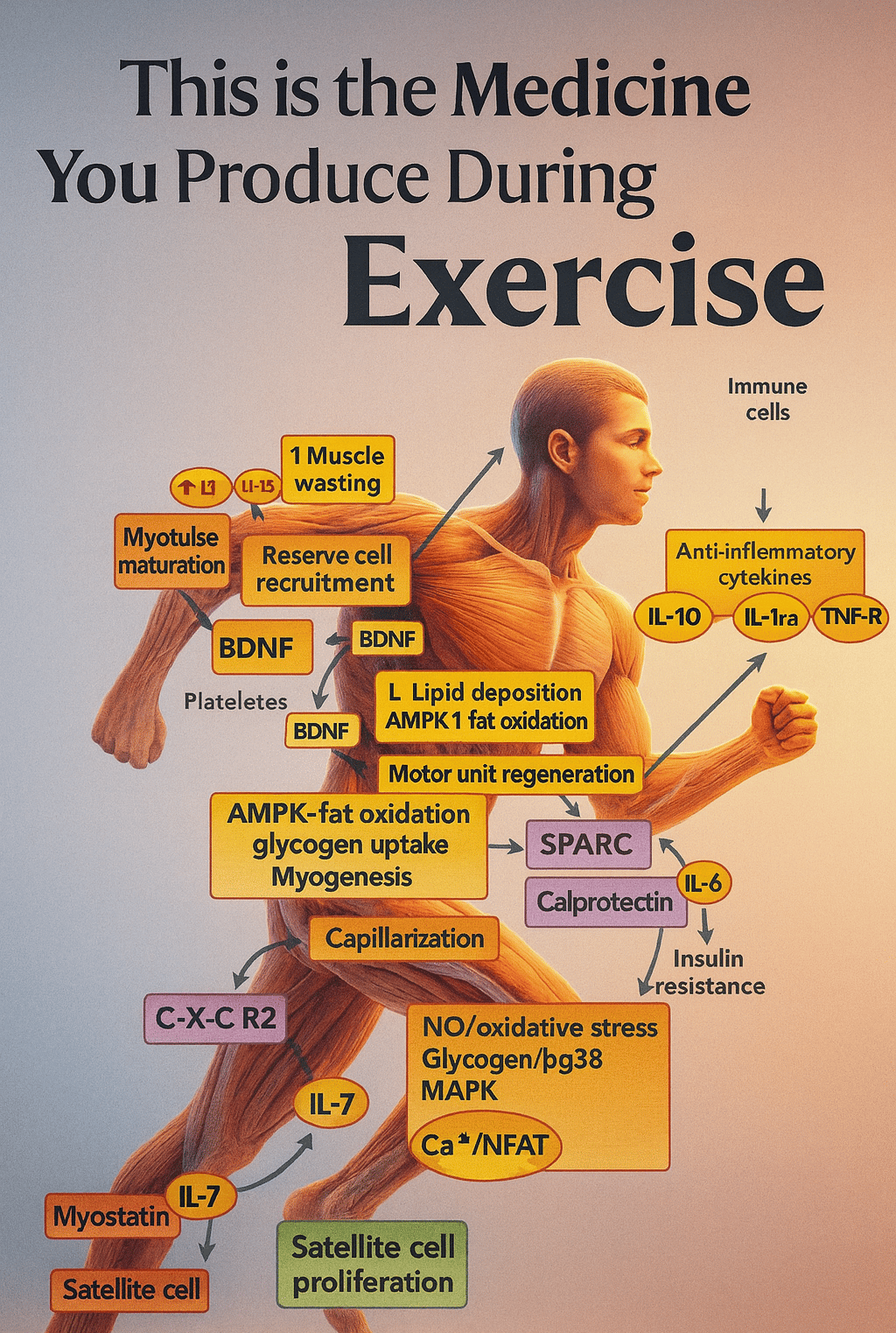
Think of them as text messages sent from your muscles to the rest of your body. They carry instructions like "burn fat," "reduce inflammation," "build new brain cells," and even "fight tumors." The diagram you might have seen—showing a runner with chemical pathways lighting up like a Christmas tree—isn't an exaggeration. It’s a map of this intricate communication network.
The "Anti-Inflammatory" Paradox: IL-6
One of the most famous myokines is Interleukin-6 (IL-6). Now, if you ask an immunologist about IL-6, they might tell you it's a "bad guy," a pro-inflammatory marker often found in chronic diseases. But here is the plot twist: when your muscles produce it during exercise, it behaves completely differently.
The Good Twin: Muscle-derived IL-6 acts as an anti-inflammatory agent. It shuts down the production of TNF-alpha (a driver of insulin resistance) and stimulates the release of other anti-inflammatory cytokines like IL-10 and IL-1ra.
The Metabolic Master: It also improves insulin sensitivity and enhances glucose uptake. Essentially, it clears the rusty pipes of your metabolism, helping you process sugar more efficiently and reducing the risk of Type 2 diabetes.
Brain Power: The BDNF Connection
Have you ever noticed that you think clearer after a run? That’s not just endorphins; that’s BDNF (Brain-Derived Neurotrophic Factor). While BDNF is primarily produced in the brain, exercise triggers a cascade that skyrockets its levels.
Think of BDNF as "Miracle-Gro" for your brain.
Neuroplasticity: It encourages the growth of new neurons and synapses, literally physically upgrading your brain’s hardware.
Mood & Memory: High levels of BDNF are linked to better memory retention and protection against depression and anxiety. It’s a natural antidepressant that also guards against neurodegenerative diseases like Alzheimer's.
The Cancer Fighter: SPARC and Oncostatin M
Perhaps the most groundbreaking discovery is the potential role of myokines in fighting cancer. Molecules like SPARC and Oncostatin M, released during physical activity, have been shown to suppress tumor growth.
They work by creating an environment that is hostile to cancer cells. For example, some myokines can induce apoptosis (cell death) in colon cancer cells or inhibit the proliferation of breast cancer cells. It transforms exercise from a "healthy habit" into a legitimate preventative therapy.
Why Pills Can’t Replace Movement
You might be wondering, "Can't I just take a myokine pill?" The answer, for now, is a resounding no. The magic lies in the cocktail. When you exercise, you aren't just releasing one substance; you are releasing hundreds of myokines in a perfectly orchestrated symphony—IL-6, IL-15, BDNF, Irisin, and many more we haven't even discovered yet.
They work synergistically. They balance each other out. A pill might give you a high dose of one, but it lacks the context and the balance of the natural biological response. The "medicine" you produce during exercise is complex, adaptive, and perfectly tailored to your body’s current state.
Conclusion
So, the next time you are struggling to find the motivation to work out, stop thinking about burning calories. Stop worrying about the number on the scale. Instead, visualize the pharmacy opening for business.
Picture the IL-6 scrubbing your arteries, the BDNF nourishing your neurons, and the legions of myokines patrolling your body for threats. You aren't just "working out." You are administering the most powerful, sophisticated, and life-extending medicine known to science. And the only way to get a refill is to move.
Frequently Asked Questions (FAQ)
How much exercise do I need to release myokines?
While any movement is better than none, myokine release is dose-dependent. Moderate to high-intensity exercise (where you get your heart rate up and muscles contracting vigorously) tends to stimulate a more robust release compared to gentle movement. Both resistance training and aerobic exercise are effective.
Can I get myokines from food?
No. Myokines are endogenous, meaning they are produced inside your body by your own muscle fibers. You cannot eat them. The only way to stimulate their production is through mechanical muscle contraction (i.e., exercise).
Do myokines help with weight loss?
Yes! Myokines like Irisin (often called the "exercise hormone") can help convert calorie-storing white fat into calorie-burning brown fat. This process, called "browning," increases your metabolic rate and helps regulate body weight.
Is it ever too late to start?
Never. Skeletal muscle retains its endocrine function well into old age. Even if you start exercising in your 70s or 80s, your muscles will still secrete these beneficial proteins, improving your brain health, immune function, and metabolic stability.
Contact
Téléphone
healthyyyyplus@gmail.com
+33 612379219